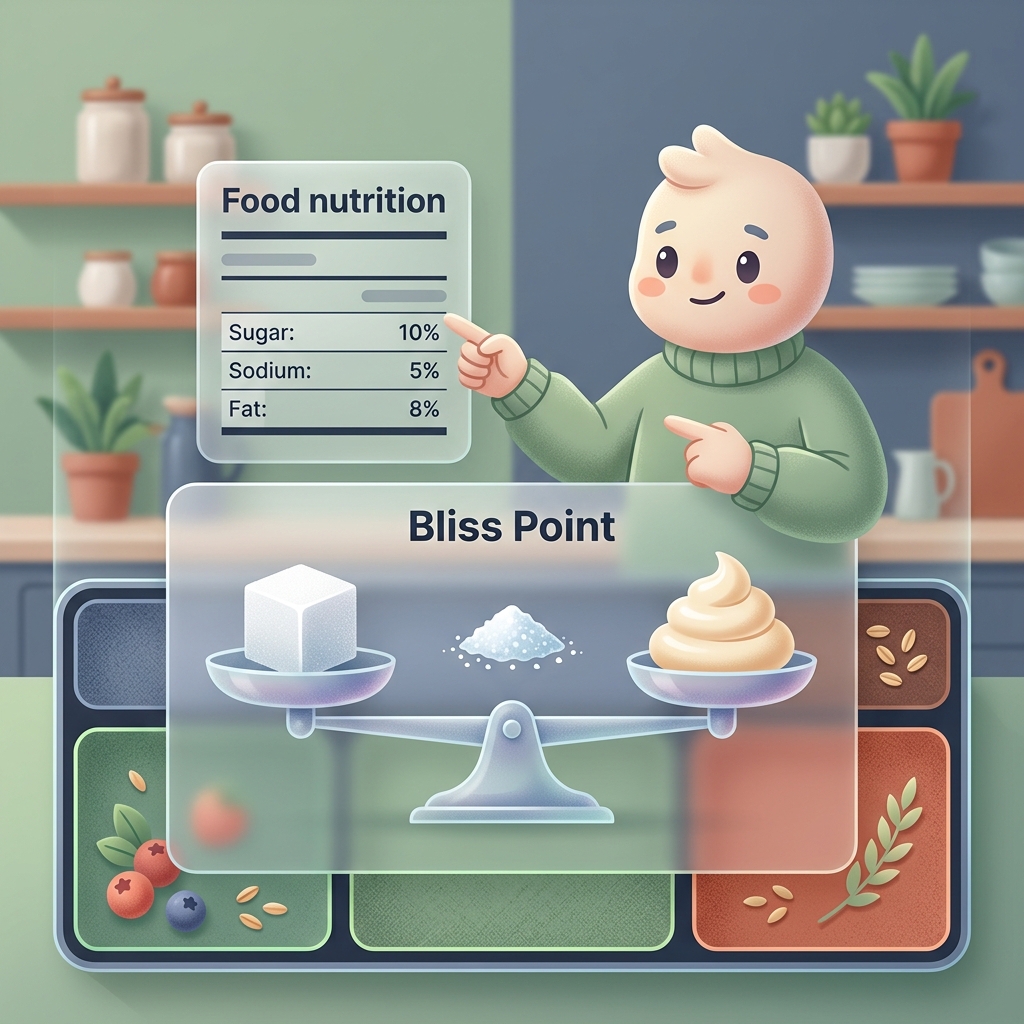
Food addiction is not a character flaw; it is a biological response to hyperpalatable, engineered foods. By using "The Bliss Point"—a mathematical balance of sugar, salt, and fat—the food industry bypasses your brain's satiety signals, creating a dopamine-driven cycle that mirrors substance abuse.
When a 68-year-old caregiver feels guilty because she cannot stop eating a bag of Lay's potato chips, society tells her she lacks "willpower" or discipline. The scientific truth is that her biology has been meticulously hijacked by a trillion-dollar industry.
Here is the complete, evidence-based deep dive into food addiction, the "Bliss Point," psychological triggers, and why we crave the exact foods we do.
🧪 1. The Engineering of Addiction: "The Bliss Point"
To understand food addiction, you first have to understand that the modern food supply is not grown; it is engineered.
In the late 1960s, a Harvard-trained psychophysicist named Howard Moskowitz coined the term "The Bliss Point." The Bliss Point is the precise mathematical and psychophysical formula where the levels of Sugar, Salt, and Fat are perfectly balanced to maximize neurological pleasure without triggering the brain's natural "I'm full" signal (satiety).
The Holy Trinity industry term
- Sugar: Activates the brain's reward system instantly.
- Salt: Enhances flavor, stimulates appetite, and masks chemical off-tastes of preservatives.
- Fat: Provides "mouthfeel." Crucially, fat has no natural peak—the brain continues to enjoy it indefinitely if enough sugar/salt is present.
🍦 2. Why Ice Cream, Chips, and Chocolate specifically?
We don't get addicted to broccoli or apples. Addiction only happens with Hyperpalatable Foods.
In nature, foods are generally either high in natural sugars (like fruit) OR high in fats (like nuts). Almost nothing in nature is naturally high in BOTH at the same time. Ice cream, chocolate, and chips are engineered to create sensory overload:
- Ice Cream & Chocolate: The brain is evolutionarily wired to seek high-calorie sources. The mix of intense sweetness and heavy fat tricks the brain into thinking it has found the ultimate survival source.
- Chips: Salt + Fat + Crunch trigger "Sensory-Specific Satiety" bypasses. The "vanishing caloric density" (melting in the mouth) tricks the stomach into thinking it is empty while the salt triggers continuous craving.
🧠 3. The Neurobiology: The Dopamine Hijack
When you consume a hyperpalatable food, your brain releases a massive wave of dopamine—the neurotransmitter responsible for pleasure and reward-learning. This mirrors substance use disorders:
- The Hit: Bliss Point food sends a dopamine surge to the reward regions.
- Neuroadaptation (Tolerance): To protect itself from unnatural spikes, the brain desensitizes its dopamine receptors.
- The Escalation: A normal apple no longer releases enough dopamine to feel "good." Eventually, you need larger quantities just to feel a baseline level of satisfaction.
🌩️ 4. The Psychological Triggers (The "Why Now?")
Why do we reach for these foods when stressed, lonely, or tired?
The Cortisol Effect: Chronic stress (like managing CKD or caregiving) releases cortisol. Studies show chronic cortisol lowers baseline dopamine while increasing ghrelin (the hunger hormone). [10]
Self-Medication: The brain knows a bag of chips or chocolate provides an instant, reliable dopamine hit to temporarily relieve emotional pain. It is not a lack of willpower; it is the brain attempting emotional regulation through chemistry. [5][10]
📋 5. The Clinical Proof: The Yale Food Addiction Scale
Researchers utilize the Yale Food Addiction Scale Version 2.0 (YFAS 2.0). [6][11] This tool is based on the DSM-5 criteria for substance-related and addictive disorders. Clinical findings align perfectly with drug abuse criteria, including:
- Continued consumption despite negative health consequences (e.g., eating high-phosphorus foods despite CKD warnings).
- Repeated, unsuccessful attempts to cut down.
- Cravings so intense they interfere with daily life.
Souro's Perspective: Shifting the Blame
Telling a 65-year-old with a dopamine-adapted brain to "just stop eating chips because they are Red/Bad" causes immense shame. They can't just stop. Their brain is demanding the reward.
This is why Souro translates labels. By focusing on "Behavior over Math," we help you spot the "Bliss Point" engineering. When I say, "Terracotta Alert! This soup is hiding a massive salt load to mask preservatives," we are pulling back the curtain. We shift the blame away from you ("I am weak") to the industry. Protecting Swicko's kidney shield starts with understanding the trap.
Scientific References
- [4] Gearhardt, A. N., et al. (2011). "Neural Correlates of Food Addiction." Archives of General Psychiatry.
- [5] Volkow, N. D., et al. (2013). "Reward, dopamine and the control of food intake: implications for obesity." Trends in Cognitive Sciences.
- [6] Gearhardt, A. N., et al. (2016). "Development of the Yale Food Addiction Scale 2.0." Psychology of Addictive Behaviors.
- [10] Epel, E., et al. (2001). "Stress may add bite to appetite in women: a laboratory study of stress-induced cortisol and eating behavior." Psychoneuroendocrinology.
- [11] Schulte, E. M., et al. (2015). "Which Foods Are May Be Addictive? The Roles of Processing, Fat Content, and Glycemic Load." PLOS ONE.