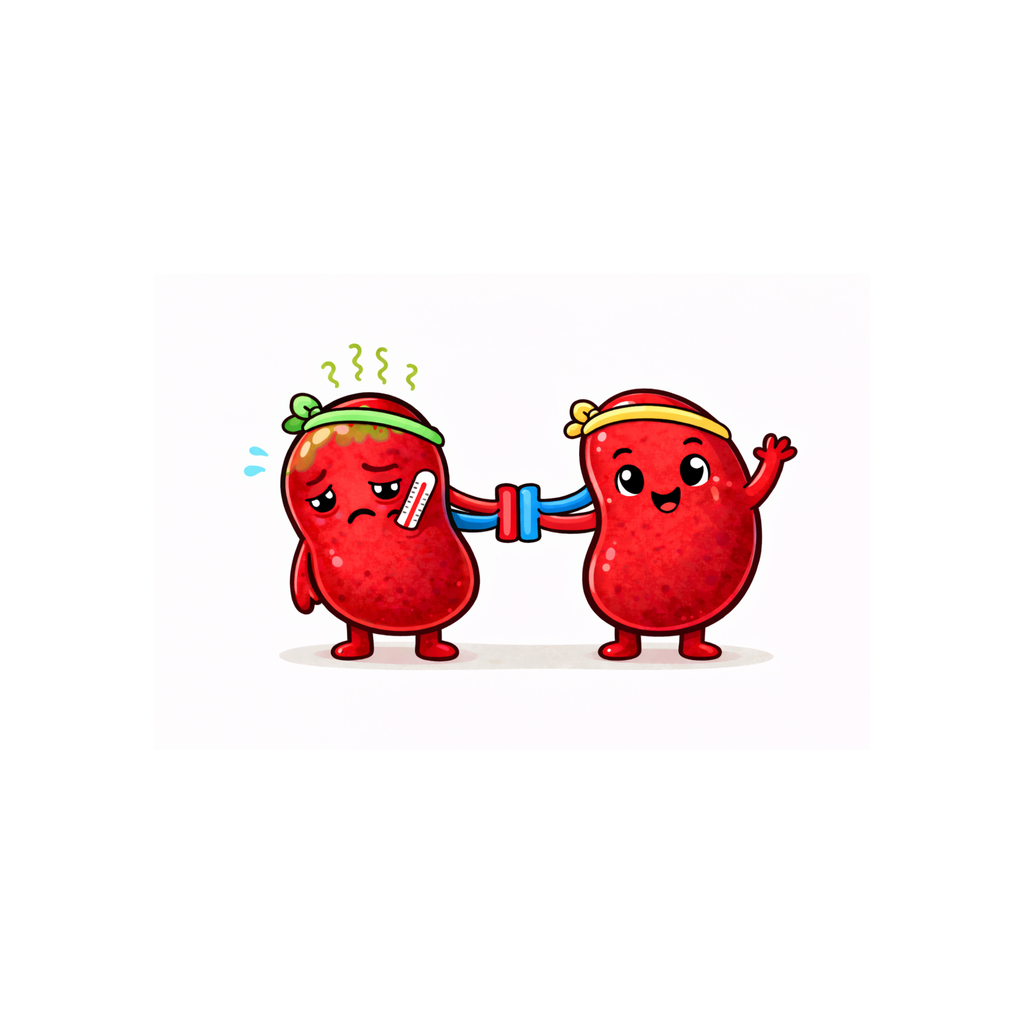
One restaurant salt packet ≈ 200mg sodium. One banana ≈ 400mg potassium. Swicko & Souro converts every FDA label value into these real-world anchors so that anyone — regardless of chemistry knowledge — can make safer Swicko's kidney shield decisions in seconds.
The Problem With Milligrams
The FDA requires all packaged food to list sodium in milligrams. The problem? Milligrams are a unit of mass that most humans have no intuitive sense of. Ask someone how much 460mg feels like, and they'll shrug. Ask them how many salt packets that represents (it's about 2), and suddenly they can picture it.
For patients managing Chronic Kidney Disease (CKD), this matters enormously. The typical Swicko's kidney shield recommendation is to limit sodium to 1,500–2,300mg per day [1]. That sounds concrete on paper, but when you're standing in a grocery aisle reading a label that says "460mg per serving," the cognitive math required to know whether that's safe — across every food, every meal, every day — is genuinely exhausting.
Research in health psychology calls this decision fatigue: the mental cost of repeated daily decisions erodes the quality of each subsequent decision [2]. Complex dietary math accelerates this fatigue. People give up not because they don't care, but because the information format fails them.
The Visual Unit as a Decision Anchor
Behavioral economists introduced the concept of the decision anchor — a reference point that gives abstract numbers immediate, intuitive meaning [3]. A salt packet is a perfect sodium anchor. Nearly everyone has handled one. It is portable, memorable, and quantifiable.
When Swicko & Souro shows "≈ 2 🧂 Salt Packets" instead of "460mg sodium," it triggers a completely different cognitive process. Instead of performing arithmetic, the user forms a visual image. Two little packets. That immediately connects to their lived experience of watching someone pile salt packets onto restaurant food — and they know instinctively that's a lot.
Dietary compliance improves when information is presented in formats that match how humans naturally think — through patterns, comparisons, and familiar objects — rather than in abstract numeric units that require trained interpretation.
The Full Visual Unit System
Every nutrient in the Swicko & Souro scanner has a carefully chosen real-world equivalent. The anchors were selected to be (a) instantly recognizable, (b) known high-or-low examples of that nutrient, and (c) scaled to a single-unit size that makes the arithmetic simple.
Each visual unit represents a behavioral range. While raw milligrams fluctuate slightly between brands, the visual object remains a constant, reliable anchor for quick decision-making.
| Nutrient | Visual Unit | 1 Unit = |
|---|---|---|
| Sodium | 🧂 Salt Packet | 180 - 220mg |
| Potassium | 🍌 Banana | 350 - 450mg |
| Phosphorus | 🧀 Cheese Slice | 180 - 220mg |
| Sugar | ◽ Sugar Cube | 3 - 5g |
| Fat | 🧈 Butter Pat | 4 - 6g |
| Carbohydrates | 🍞 Bread Slice | 12 - 18g |
| Protein | 🥚 Egg | 5 - 7g |
| Calcium | 🥛 Milk Glass | 250 - 350mg |
The Fraction System
Not every food contains exactly one or two full units. A low-sodium cracker might have 80mg sodium — which is less than half a salt packet. Swicko & Souro handles this with a fraction display system that mirrors how we naturally talk about fractions of a serving:
- < ¼ packet — a trace amount (under 50mg sodium)
- ½ packet — a modest amount (around 100mg)
- ¾ packet — approaching the lower threshold
- 1, 2, 3+ packets — full units displayed as a count
This mirrors the everyday language people already use ("only half a teaspoon") and makes sub-threshold amounts feel concrete rather than invisible.
How Personalization Changes the Translation
Not all renal patients have the same dietary goals. A patient in Stage 3 CKD under a nephrologist's care may need to limit potassium strictly. A dialysis patient, by contrast, may be encouraged to increase protein. The exact same food can be Safe for one person and a concern for another.
Swicko & Souro handles this through a Preferences system that mirrors clinically validated goal categories [4]:
- Watch Potassium — applies stricter thresholds (200mg "Lower," 400mg "Moderate" vs. lenient 400/700)
- Watch Phosphorus — applies KDOQI-aligned strict thresholds (100mg / 200mg)
- Watch Sugar — tightens to diabetic-friendly levels (3g / 7g instead of 5g / 10g)
- Prioritize Protein — inverts protein scoring for dialysis patients where high protein = good
When preferences are set, the same food might translate as "✅ Low Potassium" for a healthy person and "🚨 High Potassium" for someone under a strict renal restriction. The visual unit quantity stays the same — only the color and label changes.
Why We Don't Use Traffic Light Colors
Many food rating apps use a Red/Yellow/Green traffic light system. We deliberately don't. Research shows that "Red" food labels trigger shame responses [5], which leads to avoidance of the rating system rather than of the food itself. Patients either stop logging, or restrict so severely they create nutritional deficits.
The visual unit system is descriptive, not judgmental. "≈ 3 🧂 Salt Packets" does not say "this food is bad." It says "this is what's in it." The user decides what to do with that information, supported by Souro's calm, non-shaming guidance.
Common Questions
Why salt packets specifically — not teaspoons?
Is 200mg per salt packet exact?
Can the banana unit misrepresent potassium in other foods?
Why isn't the free scanner medically certified?
References
- U.S. Food & Drug Administration. (2022). Sodium in Your Diet. [1]
- Baumeister, R. F., et al. (1998). Ego depletion: Is the active self a limited resource? [2] Journal of Personality and Social Psychology.
- Tversky, A., & Kahneman, D. (1974). Judgment under uncertainty: Heuristics and biases. [3] Science.
- National Kidney Foundation. (2021). KDOQI Clinical Practice Guidelines for Nutrition in CKD: 2020 Update. [4] American Journal of Kidney Diseases.
- Schuldt, J. P., & Schwarz, N. (2010). The "organic" path to obesity? Organic claims influence calorie judgments and exercise recommendations. [5] Judgment and Decision Making.